
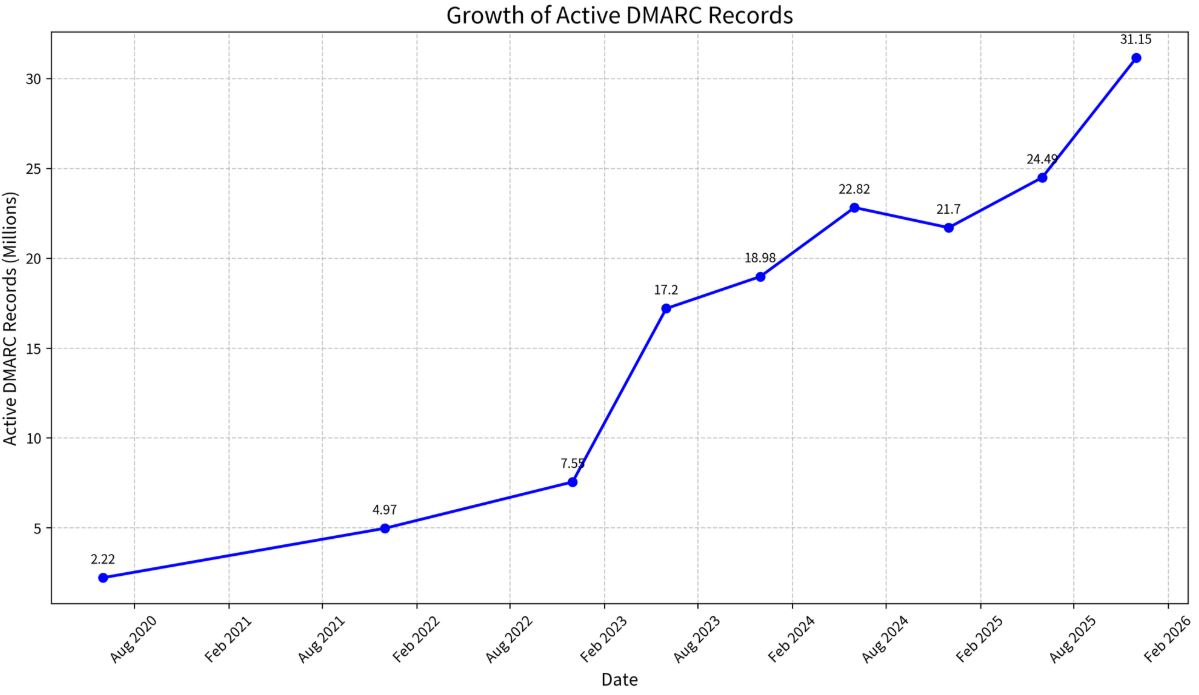
DMARC adoption continued to grow rapidly through 2025, with more than 31.1 million valid DMARC records observed in DNS by the end of the year. While deployment reached record levels, most domains still use monitoring-only policies rather than full enforcement.
Data source: The figures in this report are based on DNS observations provided by DomainTools and DMARC.org. Although the dataset does not cover the entire Internet, it provides a consistent view of adoption trends over time.
DMARC Adoption Growth (31 Million Records)
The number of active DMARC records grew from 2.2 million in mid-2020 to 31.1 million by December 2025, as shown in the table below;
| Date | Active DMARC Records |
|---|---|
| Jun 2020 | 2.22 Million |
| Dec 2021 | 4.97 Million |
| Dec 2022 | 7.55 Million |
| Jun 2023 | 17.20 Million |
| Dec 2023 | 18.98 Million |
| Jun 2024 | 22.82 Million |
| Dec 2024 | 21.70 Million |
| Jun 2025 | 24.49 Million |
| Dec 2025 | 31.15 Million |
Growth accelerated sharply during 2023 and again in the second half of 2025. The sharp growth in 2023 is attributed to the introduction of DMARC authentication requirements for bulk email senders (sending 5,000 or more emails per day to Gmail or Yahoo accounts).
The Google and Yahoo authentication requirements meant marketers with properly configured DMARC could expect:
- Improved inbox placement
- Greater sender reputation
- Reduced domain spoofing
- Higher customer trust
- Better protection against phishing campaigns impersonating their brand
Monthly publication data shows the same trend. Early 2020 typically saw fewer than 100,000 new records each month. By late 2025, several months exceeded 1.5 million new DMARC records, with the highest month approaching 1.8 million.
Most Domains Still Use Monitoring Mode ( p=none)
Despite strong adoption, enforcement remains limited.
At the end of 2025:
- 65.7% published p=none
- 20.6% published p=quarantine
- 13.8% published p=reject
A p=none policy collects reports but does not tell receiving mail servers to block or quarantine spoofed email.
The policy mix has changed very little in recent years. Monitoring remains the default choice for nearly two-thirds of published DMARC records.
You can learn more about factors that affect email deliverability or use our free tool to check your email deliverability score.